Swiftproxy Review 2026: A Flexible Residential Proxy Provider for Web Scraping and Data Collection
Swiftproxy full review
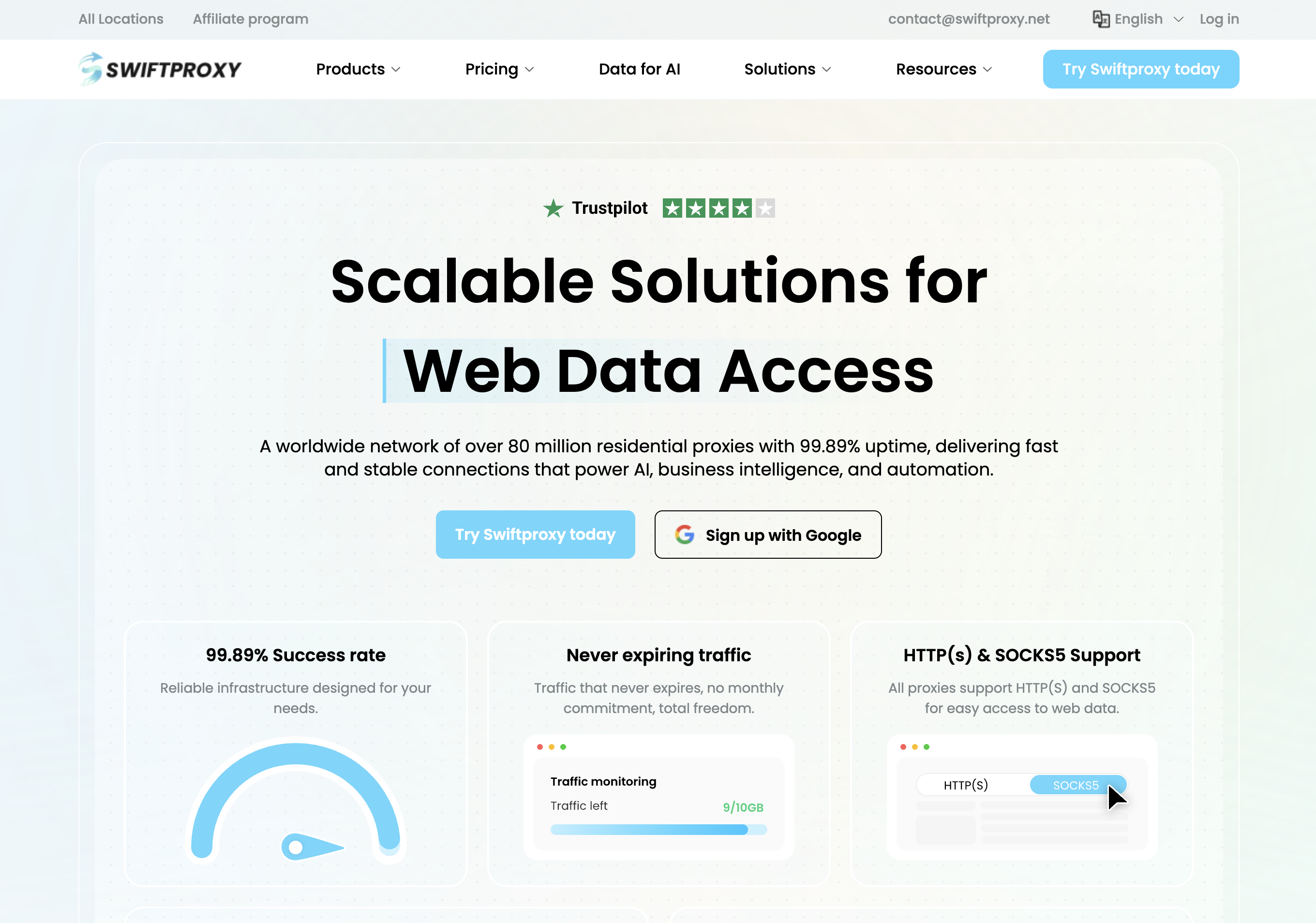
As web scraping, SEO monitoring, market research, and automated data collection continue to grow, choosing the right proxy provider has become increasingly important. A reliable proxy network needs to offer more than a large IP pool. Geographic coverage, session control, connection protocols, pricing flexibility, and IP quality can all have a significant impact on the success of a data collection project.
Swiftproxy is a proxy provider focused on residential and static residential proxies. The service provides access to a large residential IP network covering more than 195 locations, together with flexible session controls and support for HTTP(S) and SOCKS5.
In this Swiftproxy review, we look at its proxy types, pricing, features, use cases, advantages, limitations, and overall value for users who need residential IPs for online data operations.
What Is Swiftproxy?
Swiftproxy is a proxy service designed primarily for web scraping, automation, SEO research, market intelligence, price monitoring, ad verification, and other applications that require access through geographically distributed IP addresses.
The provider offers two main categories of proxies: Residential Proxies and Static Residential Proxies.
Its residential proxy network includes more than 80 million IPs across 195+ locations. Users can select specific countries and, depending on availability, more granular locations such as cities and ASNs.
Residential proxies are generally suited to projects that require IP rotation and access to a large number of different addresses. Static residential proxies, on the other hand, are designed for situations where maintaining the same IP for a longer period is more important.
This makes Swiftproxy suitable for both short-term scraping jobs and longer-running workflows where IP consistency matters.
Swiftproxy Pricing
One of the more notable aspects of Swiftproxy is its relatively straightforward pricing structure.
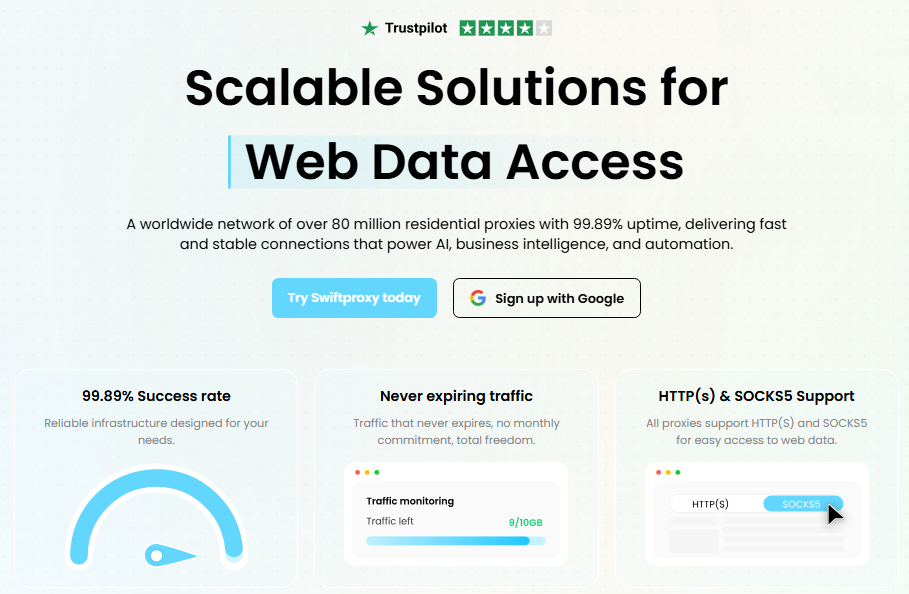
Residential proxies start at around $0.70 per GB, while static residential proxies start at approximately $6 per IP.
The residential proxy traffic model is also designed to provide flexibility. Unused residential traffic does not expire, meaning users do not necessarily need to consume their entire traffic allocation within a fixed billing period.
This can be useful for smaller teams, developers, and businesses whose proxy requirements change from one project to another. Instead of purchasing bandwidth every month simply to maintain access, users can use their available traffic when it is actually needed.
Static residential proxies follow a different pricing model, with users purchasing individual IPs rather than bandwidth-based residential traffic.
Key Features
Large Residential IP Pool
Swiftproxy provides access to more than 80 million residential IPs across 195+ locations.
A large IP pool can be particularly useful for large-scale scraping projects, where repeatedly accessing websites from the same addresses can increase the likelihood of blocks or rate limitations.
The broad geographic coverage also allows users to collect localized information and test websites from different markets.
Rotating and Sticky Sessions
Swiftproxy supports both rotating and sticky residential proxy sessions.
Rotating sessions are useful when a project requires frequent IP changes. This can be helpful for large-scale data collection, search engine scraping, price monitoring, and similar workloads.
Sticky sessions allow users to maintain the same IP for a specified session instead of switching addresses with every request. This can be useful for websites or applications where session consistency is important.
Having both options gives users more control over how their proxy connections behave.
Country, City, and ASN Targeting
Geographic targeting is another important feature for data collection.
Swiftproxy supports country-level targeting and provides more granular targeting options in supported locations. Users can select specific cities or ASNs when their application requires traffic to originate from a particular geographic or network environment.
This can be especially useful for localized SEO research, competitor analysis, price comparison, advertising verification, and regional website testing.
HTTP(S) and SOCKS5 Support
Swiftproxy supports both HTTP(S) and SOCKS5 proxy connections.
This allows the proxies to be used with a wide range of scraping frameworks, browsers, automation tools, and custom applications. Users can also integrate the service through API-based workflows or username and password authentication.
The provider also supports integration with a wide range of third-party tools, which can make deployment easier for users who do not want to build their proxy infrastructure from scratch.
Static Residential Proxies
For applications where a consistent IP address is more important than rotation, Swiftproxy provides static residential proxies.
Static residential proxies can be useful for account management, long-running sessions, automation workflows, and applications where frequent IP changes could interrupt an existing session.
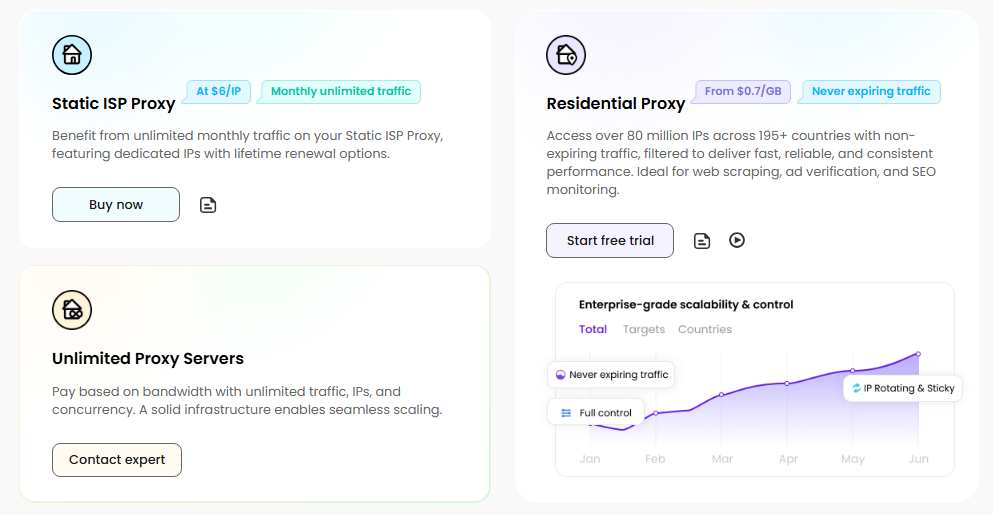
Swiftproxy's static residential plans start at approximately $6 per IP and provide unlimited traffic during the active period.
Common Swiftproxy Use Cases
Swiftproxy's residential network can be used for a wide variety of data-related applications.
Web Scraping
Web scraping is one of the most obvious use cases for residential proxies.
A large rotating IP pool can help distribute requests across different residential addresses, which can be useful when collecting large volumes of public web data.
Swiftproxy can be used with scraping frameworks and automation tools for applications such as product data collection, content monitoring, market research, and database building.
SEO and SERP Monitoring
SEO professionals often need to check search results from different locations.
Residential proxies allow users to make requests from different geographic locations, making it easier to monitor localized search results, track rankings, analyze competitors, and conduct keyword research.
City and country targeting can be particularly useful when search results vary significantly between regions.
Price Monitoring and Market Research
E-commerce prices, product availability, and promotions can differ depending on location.
For this reason, residential proxies can be useful for companies that regularly monitor product listings and pricing information across different markets.
Swiftproxy's geographic targeting options allow users to collect localized information without relying on a single IP address or location.
Ad Verification
Advertising teams and agencies can use residential proxies to check whether advertisements are being displayed correctly in specific regions.
This can help with campaign verification, competitor research, and detecting discrepancies between expected and actual ad placements.
Social Media and Automation
Residential and static residential proxies can also be used for certain social media management and automation workflows where geographic distribution or IP consistency is important.
Static residential proxies may be more appropriate for workflows that require a consistent connection, while rotating residential proxies can be useful for tasks involving larger numbers of requests.
Pros and Cons
Pros
- Large residential IP pool with more than 80 million IPs
- Coverage across 195+ locations
- Residential proxies starting at $0.70/GB
- Non-expiring residential traffic
- Rotating and sticky session options
- Country, city, and ASN targeting
- Support for HTTP(S) and SOCKS5
- Static residential proxies available
- Suitable for web scraping, SEO, market research, and automation
- API and username/password authentication
- Support for a wide range of third-party tools
Cons
- Static residential coverage is more limited than the overall residential network
- Users looking exclusively for dedicated data center proxies may find other providers more specialized for that use case
- Some advanced proxy requirements may require users to select the appropriate proxy type and session configuration before starting a project
Is Swiftproxy Easy to Use?
Swiftproxy follows a relatively standard proxy setup process.
Users can select a proxy type, choose their desired location and session settings, and then obtain the necessary proxy credentials. The service supports both API-based workflows and standard authentication, allowing it to be integrated into custom applications as well as existing scraping tools.
For developers, HTTP(S) and SOCKS5 support means that the service can be used with many commonly used libraries and frameworks without requiring a specialized integration.
The availability of documentation and integration guides is also useful for users who are setting up residential proxies for the first time.
Who Should Consider Swiftproxy?
Swiftproxy is particularly suitable for users who need residential IPs for data-oriented applications rather than occasional browsing.
It can be a good fit for:
- Web scraping teams
- SEO professionals
- Market research companies
- E-commerce businesses
- Price monitoring services
- Data collection projects
- Advertising and ad verification teams
- Developers building scraping or automation applications
- Agencies managing multiple online projects
The non-expiring traffic model can also make Swiftproxy worth considering for users with irregular proxy requirements. Someone who only runs large scraping jobs periodically may benefit from being able to retain unused traffic rather than losing it at the end of a monthly billing cycle.
Swiftproxy vs. Other Residential Proxy Providers
Residential proxy providers tend to differentiate themselves through IP pool size, geographic coverage, pricing, session management, and traffic policies.
Swiftproxy's main selling point is the combination of a large residential network and flexible traffic usage.
Its starting price of $0.70/GB places it in a competitive range for residential proxy services, while the non-expiring traffic model can potentially provide additional value for users whose bandwidth consumption varies significantly.
The availability of both rotating residential and static residential products also means users do not necessarily need to switch providers when their requirements change from rotating IPs to persistent connections.
However, users should still evaluate proxy quality, target-site compatibility, location availability, and performance for their specific workloads before committing to a large-scale deployment. Proxy performance can vary depending on the target website, geographic region, and type of traffic being generated.
Final Verdict
Swiftproxy is a flexible residential proxy provider aimed at users who need scalable IP infrastructure for web scraping, SEO, market research, automation, and other data collection tasks.
Its main strengths are its 80M+ residential IP pool, coverage across 195+ locations, rotating and sticky sessions, geographic targeting, support for HTTP(S) and SOCKS5, and non-expiring residential traffic.
The availability of static residential proxies also gives users an option for workflows that require consistent IP addresses rather than frequent rotation.
Overall, Swiftproxy is worth considering for individuals, developers, agencies, and businesses looking for a residential proxy service with broad geographic coverage and flexible usage. Its pricing and non-expiring traffic model are particularly attractive for users whose proxy requirements fluctuate between projects.
For users evaluating residential proxy providers in 2026, Swiftproxy offers a practical combination of network scale, flexibility, and multiple proxy options, making it a solid candidate for modern web data collection and online research workflows.